
| TL;DR Standard tee canvas is 4500 × 5400 pixels. The safe zone inside it is 3600 × 4800, or 12 by 16 inches.Everything ships at 300 DPI, as PNG-24 with transparency, in sRGB. Not CMYK. Not JPEG.Hoodies are 4500 × 4050, totes and pillows 2925 × 2925, PopSockets grips 485 × 485.Test every design at 200 × 200 pixels. That is roughly the size at which the buying decision is made. Short version: the canvas and the safe zone are different numbers, and designing to the canvas is the most common reason a design looks right on screen and wrong on a shirt. |
Two dimensions govern a t-shirt design and only one of them is the file size.
The upload canvas is 4500 × 5400 pixels, which at 300 DPI is 15 by 18 inches. The safe zone, the region you can rely on being printed correctly across sizes and cuts, is 3600 × 4800, or 12 by 16 inches. That is 71% of the canvas area.
Design to the canvas and the outer band of your artwork is at the mercy of garment size and print placement. Design to the safe zone and you know what you are getting.
The full spec sheet, product by product, is set out in this guide to Amazon Merch product types and artwork specs.
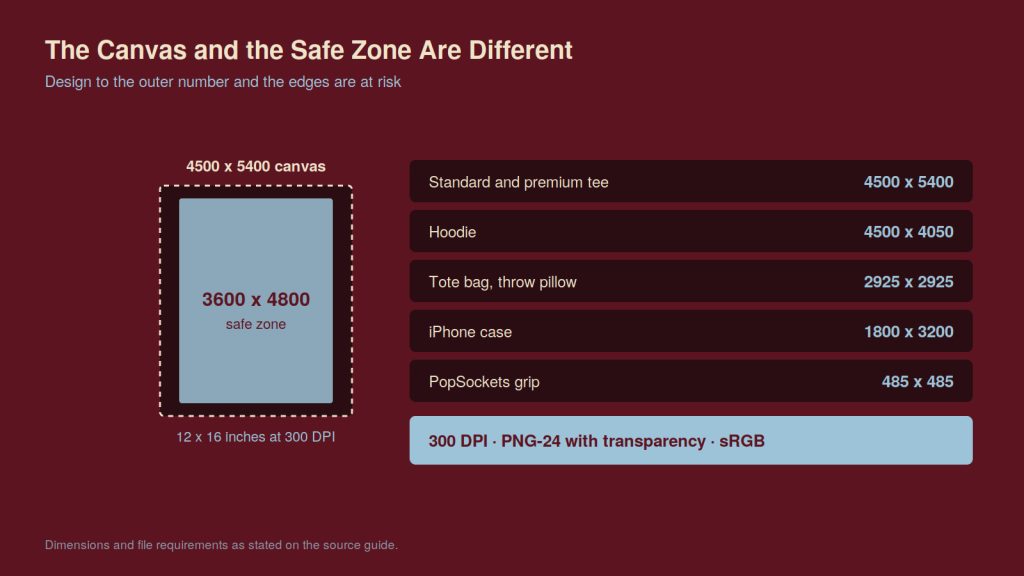
The safe zone is 71% of the canvas area. The other 29% is the part that varies.
The Dimensions, by Product
Aspect ratio varies more than size does, and that is what forces real work rather than resizing.
| Product | Canvas |
| Standard and premium t-shirt | 4500 × 5400 |
| Hoodie | 4500 × 4050 |
| Tote bag, throw pillow | 2925 × 2925 |
| iPhone case | 1800 × 3200 |
| PopSockets grip | 485 × 485 |
A tee is portrait at exactly 5:6. A hoodie is landscape at 10:9, because the print sits above a pocket pouch. A tote is square. A phone case is a tall 9:16.
Those are four genuinely different compositions. A design built as a tall stacked lockup for a tee cannot be scaled into a hoodie’s landscape field without either shrinking to nothing or being rebuilt, and the rebuild is the correct answer. Sellers who batch-resize one artwork across all product types produce a good shirt and four compromised products, and the four compromised ones still cost review time and still carry the brand.
The File Requirements Are Not Preferences
Four requirements, and each one has a reason.
300 DPI. Print resolution, not screen resolution. A 72-DPI image scaled up will pass upload and print soft.
PNG-24 with transparency. The transparency is the point. Anything opaque behind your artwork prints as a rectangle of ink on the garment.
sRGB color space. Not CMYK, even though CMYK is the print convention elsewhere. Submitting CMYK produces a color shift you did not choose.
Not JPEG. JPEG has no alpha channel and its compression introduces artifacts around hard edges, which is exactly where t-shirt lettering lives.
On the format specifically, the W3C’s PNG specification, which reached Recommendation status in June 2025, describes the format as providing “the lossless, portable, well-compressed storage of static and animated raster images,” supporting “indexed-color, greyscale, and truecolor images… plus an optional alpha channel.” That alpha channel is what carries the transparency, and the spec is explicit about how it behaves: “an alpha value of zero represents full transparency,” with full opacity at the other end of the range.
Which means partial transparency is real and is preserved. Soft-edged shadows and antialiased type survive the round trip, and that is worth knowing because it is the practical difference between hard-edged clip art and artwork that looks made for the garment.
Design for the Thumbnail, Not the Canvas
Here is the constraint that should govern the composition, and it is not in the spec sheet.
Nobody buys a t-shirt from a 4500-pixel file. They buy it from a search results grid, at roughly 200 × 200 pixels, on a phone, while scrolling.
So the test is: export at 200 × 200 and look at it. Zooming your working file will not substitute unless you do the arithmetic, and the arithmetic is unforgiving: 200 pixels of a 4,500-pixel canvas is under 5% zoom, not the 25% that feels small. If the concept does not read at that size, it does not read at all, and no amount of detail in the full-resolution file recovers it.
The practical rule that falls out of this is a headline of five to seven words maximum. Beyond that, at thumbnail scale, the words become texture. A seven-word joke that lands at 200 pixels beats a twelve-word joke that only works when someone has already clicked, because the click is the thing you are trying to earn.
Which Products to Start With
The dimension table is also a difficulty ranking, and it is worth reading that way.
Standard tees are the highest volume and the most competitive, and they price at $15.99 to $19.99. Premium tees start around $23.99, hoodies run $29.99 to $34.99. The higher-priced products carry more royalty per unit and considerably less competition, and they also demand designs that survive a different aspect ratio.
The reasonable sequence is to prove the design on a tee, then rebuild rather than resize it for one other format that genuinely suits it. A dense illustrative design suits a tote. A wordmark suits a hoodie. A single icon suits a grip. Matching the design to the product beats covering every product with the same file.
Build the Seasonal Calendar From the Print Date Backwards
One scheduling note, because it is a spec of a different kind.
Seasonal designs need 4 to 6 weeks ahead of the peak as a minimum. Note that the peak is not the holiday. Christmas buying concentrates through late November and early December, so four to six weeks ahead of it means live in the second half of October, not the second half of November.
The reason is indexing rather than shopper behavior. A listing needs time to be found before the buying window opens, and a design published into the middle of the window is competing against listings that have been accumulating signals for a month. Six to eight weeks ahead of the holiday itself is the safer read of the same rule, and nothing is lost by being early.
Which makes December’s revenue an October production problem, and October’s calendar the one that decides it.